







Artemis II Returns: Completes Historic Lunar Mission with Pacific Splashdown
The mission, crewed by NASA astronauts Reid Wiseman, commander, Victor Glover, pilot, Christina Koch, mission specialist, and CSA (Canadian Space Agency) astronaut Jeremy Hansen, mission specialist, completed a flyby of the Moon and returned to Earth. Photo: EFE.
April 10, 2026 Hour: 10:00 pm
🔗 Comparte este artículo
In the final stretch of their lunar voyage, astronauts experienced Orion’s critical re-entry into the Earth’s atmosphere, while Artemis II reached temperatures of up to 2,700 degrees outside and a speed of over 40,200 kilometers per hour.
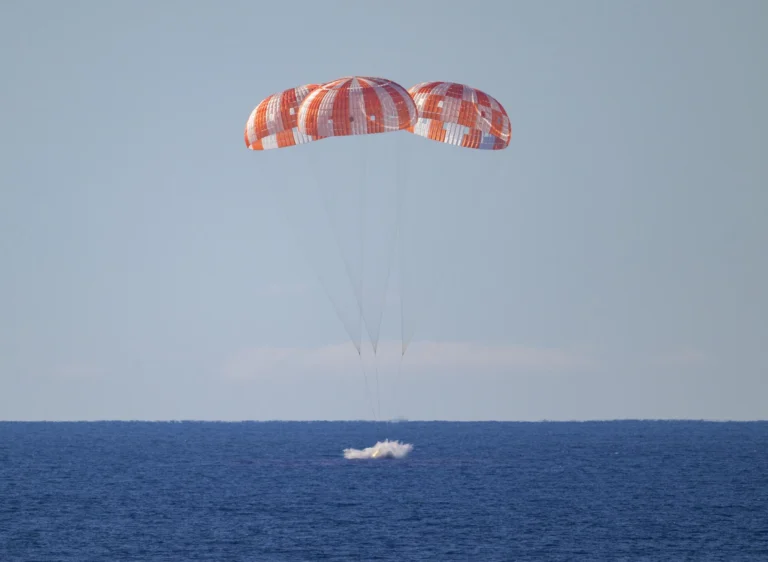
NASA’s Orion capsule, carrying four Artemis II astronauts, splashed down in the Pacific Ocean today, April 10, completing the first crewed lunar mission in 53 years after a critical re-entry.
The successful conclusion marks a pivotal moment for human space exploration, paving the way for future lunar landings and deep space ventures.
Approximately 40 minutes after undocking from the Orion service module, the capsule, carrying astronauts Reid Wiseman, Christina Koch, Victor Glover, and Jeremy Hansen, safely splashed down on Friday night in the Pacific Ocean. The precise landing occurred around 8 P.M. EST, approximately 3,704 kilometers off the coast of San Diego, California.
The astronauts successfully navigated the capsule’s re-entry in autopilot mode into Earth’s atmosphere, a phase where the vehicle’s exterior endured extreme temperatures of up to 2,700 degrees Celsius and reached a staggering speed exceeding 40,200 kilometers per hour during its descent. The entire mission, spanning 10 days, saw Artemis II travel more than 643,000 kilometers, pushing the boundaries of human endurance and technological capability.
The impact with Earth’s atmosphere occurred at an astonishing Mach 33-33 times the speed of sound. Tensions in Mission Control momentarily surged as the capsule became enveloped in a red-hot plasma sheath during the peak heating phase. This phenomenon led to a planned six-minute communications blackout, a standard occurrence when re-entry modules delve into the gaseous layer surrounding Earth.
The approximately 14 minutes of re-entry represented a critical maneuver for the mission, paralleling the more than eight minutes of high risk during the launch from Florida on April 1.
NASA had previously explained, “Seconds after entry, we will begin a six-minute period of communication interruption due to the ionization that will generate a layer of plasma around the spacecraft, which will prevent us from receiving communications and data.” This technical challenge highlights the precision engineering required for such demanding space missions, underscoring the ingenuity of the teams involved.
This was not the only instance of communication loss during the mission. A similar blackout occurred for about 40 minutes last Monday, when Orion was flying over the far side of the Moon, making any connection with Mission Control impossible. Despite these anticipated challenges, the crew and capsule performed flawlessly. After re-entering Earth’s atmosphere, the intense friction with the air at such high entry speeds gradually slowed the spacecraft. At an altitude of approximately 6,200 meters, the braking parachutes were deployed, ensuring a controlled descent until it gently settled into the Pacific waters.
There, ships from the U.S. Armed Forces were awaiting its arrival. A specialized group from the Navy greeted the crew, prepared to conduct thorough medical evaluations of the four astronauts, prioritizing their health and safety after their arduous journey.
NASA has indicated that upon their return, the crew members will undergo comprehensive medical check-ups and spend crucial time with their families. Consequently, they are expected to defer any statements to the press for several weeks.
The successful conclusion of Artemis II not only fulfills a 53-year hiatus in crewed lunar travel but also sets a strong precedent for the broader Artemis program’s objectives. These include establishing a sustainable human presence on the Moon and preparing for future human missions to Mars.
The data gathered from this historic flight, particularly concerning the re-entry dynamics and human performance in deep space, will be invaluable for shaping the next era of space exploration, reaffirming humanity’s enduring quest to explore the cosmos.
Author: Laura V. Mor
Source: Agencies